 A woman gathering firewood
"We assemble ambitions faster than solutions. At the outset of the 21st Century high on the lists of global ambitions compiled, for example …the eradication of poverty and hunger, universal access to plentiful fresh water and energy and environmental sustainability. The world is not on target to meet any of these objectives. We have not yet committed the time, effort and money they require. And while it has proved relatively easy to marginally adjust our business as usual plans towards these ambitions and call that progress, it much harder to identify a clear long term vision that meets these ambitions, calculate what is required to get there from here and then follow through."
Nuclear Power in the 21st Century and Its Role in Developing Countries
Yury A. Sokolov, Vladimir S. Kagramanyan and Alan McDonald
Department of Nuclear Energy, International Atomic Energy Agency,
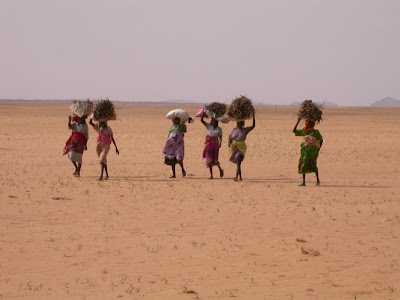
The importance of modern energy sources in Africa cannot be be over emphasized as it is the nucleus of socio-economic development globally. A large number of Africans depend on charcoal and firewood reflecting the comparatively low level of industrialisation in Africa.
To move out of this phase will require substantial increase in cost effective and affordable energy sources, that are environmentally friendly and ensure social equability and sustainability. Africa is the smallest consumer of primary energy in the world and therefore per Capita primary energy needs to be increased in order for Africa to be competitive.

Nuclear Energy in Africa: Nuclear power generation contributes to the global electricity mix by providing over 16% of world electricity.Currently South Africa has the only nuclear power plant on the continent of Africa. South Africa has two nuclear reactors generating 6% of its electricity. Its first commercial nuclear power reactor began operating in 1984.
Government commitment to the future of nuclear energy is strong.South Africa's rapidly dwindling coal reserves mean the country may need a source of cleaner, better energy by as early as 2008. The government insists that nuclear power could play a crucial role in South Africa's future energy mix. Although South Africa's coal reserves are vast - they are measured in billions of tons - fossil fuels do not last forever, and South Africa's are rapidly depleting. South Africa's interest in nuclear power is part of a growing, albeit tentative, international trend, and comes amid forecasts that the global demand for energy will double in the next 25-30 years. More and more governments are now exploring the possibility of nuclear energy for the first time since the Chernobyl disaster in 1986. However, the future of the country's energy would involve private-sector involvement in the construction of power stations and nuclear power facilities. This has proved to be a difficult task to secure a credible and stable international partner who is prepared to stick around. Coupled with this are objections to the government's nuclear programme from environmental lobbyists. South Africa is planning to build a second nuclear reactor.
Government commitment to the future of nuclear energy is strong.South Africa's rapidly dwindling coal reserves mean the country may need a source of cleaner, better energy by as early as 2008. The government insists that nuclear power could play a crucial role in South Africa's future energy mix. Although South Africa's coal reserves are vast - they are measured in billions of tons - fossil fuels do not last forever, and South Africa's are rapidly depleting. South Africa's interest in nuclear power is part of a growing, albeit tentative, international trend, and comes amid forecasts that the global demand for energy will double in the next 25-30 years. More and more governments are now exploring the possibility of nuclear energy for the first time since the Chernobyl disaster in 1986. However, the future of the country's energy would involve private-sector involvement in the construction of power stations and nuclear power facilities. This has proved to be a difficult task to secure a credible and stable international partner who is prepared to stick around. Coupled with this are objections to the government's nuclear programme from environmental lobbyists. South Africa is planning to build a second nuclear reactor.
ESKOM the South Africa electricity utility, operates a 2 unit site at Koeberg Nuclear Power Station near Capetown. Koeberg Power Station is the only nuclear power station on the African continent. It is situated at Duynefontein, 30km northwest of Cape Town in South Africa on the Atlantic coast. Koeberg ensures a reliable supply of electricity to the Western Cape one of the fastest growing regions in South Africa. It has operated safely for more than 21 years and efficiently for a decade and has a further active life of 30 - 40 years.
The stations' two reactors supply 1 800MW or 6 ofSouth Africa Kalahari Desert .
The stations' two reactors supply 1 800MW or 6 of

High level waste, the spent fuel, is stored on site in special pools equipped with high-density racking. Koeberg ranks amongst the safest of the world’s top-ranking PWR’s of its vintage and is vital for grid stability in the Cape.
During 2002, Koeberg was awarded NOSCAR status for the 7th consecutive year by the National Occupational Safety Association (NOSA).

Koeberg's two reactor containment buildings are made of concrete 1m thick, lined with steel. They are designed to ensure that no radiation escapes under any conceivable circumstances, from an earthquake to a jumbo jet collision.
 Inside the nuclear reactor facilities
NUCLEAR ENERGY HOPES IN THE REST OF AFRICA
EGYPT
The son of Egypt's president Gamal Mubarak urged his father's party to consider a proposal to develop nuclear energy.
"We will continue using our natural energy resources, but we should conserve these resources for our future generations. The whole world is looking at alternative energy — so should Egypt — including nuclear,"
Gamal Mubarak told party members gathered in Cairo. More Information
Gamal Mubarak told party members gathered in Cairo. More Information
LIBYA: A nuclear power agreement with the United States will be signed shortly. Libya's official news agency says the US will help build a nuclear power plant for electricity and civil uses. An anonymous US official downplayed development on BBC on March 2007. Libya wants to use nuclear energy to tackle projected water shortages. More information
Zimbabwe Zimbabwe
ZIMBABWE: Zimbabwe President Robert Mugabe shocked the world in November 2006 when he announced


